
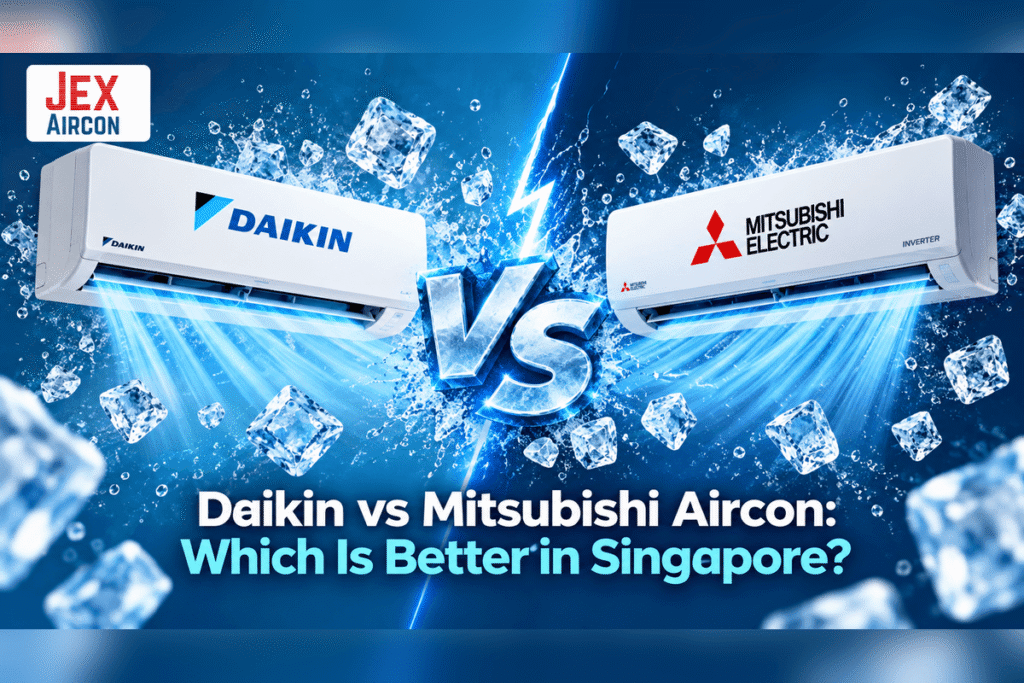
When choosing a new aircon for your home in Singapore, you will often find yourself narrowing it down to two familiar names: Daikin and Mitsubishi aircon. Both are trusted aircon brands with their own strengths, whether it comes to energy efficiency, noise level, features, price, or ease of maintenance. So, the real question is not which one is better overall, but which one fits the way you live.
Daikin vs Mitsubishi Aircon: What’s the Difference?
Daikin and Mitsubishi Electric are both established Japanese brands with a wide range of residential aircon systems, but their models come with different features and specifications. Instead of asking which brand is better overall, it is more useful to look at the features that matter most to your home and lifestyle. Here are the key factors to consider when choosing between the two.
1. Cooling Performance
Both Daikin aircon and Mitsubishi Electric aircon use inverter technology, which allows the aircon to adjust its cooling output based on the room’s cooling needs. However, actual cooling performance depends not only on the brand but also on the model, room size, capacity and installation.
- Daikin Aircon
- The Daikin iSmile Eco+ range uses inverter technology to adjust cooling based on demand.
- It is available in different system configurations, from System 1 to System 5.
- The range is designed for quiet everyday cooling.
- Mitsubishi Electric Aircon
- The Mitsubishi Electric Starmex range also uses inverter technology.
- The FP Series offers multi-split systems from System 2 to System 5.
- The GP Series is available for single-split setups.
Important Note: Whichever aircon brand you choose, getting the right cooling capacity is important. Room size, sun exposure, ceiling height, number of occupants and installation quality can all affect how well your aircon cools the space.
2. Energy Efficiency
Energy efficiency is an important consideration in Singapore, especially if you use your aircon every night or for several hours a day. Both brands offer energy-efficient inverter systems, including models with Singapore’s 5-tick energy rating.
- Daikin Aircon
- The current iSmile Eco+ System 2 to System 5 options include 5-tick models.
- The range uses inverter technology, which adjusts the compressor according to cooling demand.
- Current models use R32 refrigerants.
- Mitsubishi Electric Aircon
- The Starmex FP Series offers 5-tick options from System 2 to System 5.
- The FP Series uses inverter technology and R32 refrigerant.
- The Starmex GP Series also uses R32 for selected single-split systems.
Important Note: A 5-tick rating does not automatically mean one brand will use less electricity than the other. Your actual energy consumption also depends on the specific model, cooling capacity, room conditions, temperature setting and how long you run the aircon.
3. Noise Level
Noise can make a noticeable difference, especially when the aircon is installed in a bedroom. Nobody wants an aircon that is constantly humming in the background, especially when sleeping or working.
- Daikin Aircon
- The iSmile Eco+ range is designed for quiet cooling.
- Inverter operation can help reduce the need for the compressor to run at full power continuously.
- Mitsubishi Electric Aircon
- Quiet operation is one of the key features of the Starmex range.
- Selected Starmex models can operate at noise levels as low as 19 dB.
- This can be useful if you are especially sensitive to aircon noise in bedrooms or other quiet spaces.
Important Note: Noise levels are measured in decibels (dB), and a lower number means quieter operation. If noise is important to you, check the noise level of the exact model rather than comparing the brands as a whole.
4. Smart Features and Wi-Fi Control
Being able to control your aircon from your phone can be useful if you want to turn the aircon on before you get home or adjust the temperature without reaching for the remote.
- Daikin Aircon
- All iSmile Eco+ systems come with built-in Wi-Fi.
- Smartphone control allows you to adjust the aircon remotely.
- Wi-Fi availability depends on the specific system and model.
- Mitsubishi Electric Aircon
- Currently, Mitsubishi Electric Starmex models do not support Wi-Fi phone control.
- Some systems may require an additional accessory for smart control.
Important Note: If smartphone control is important to you, check whether Wi-Fi is built into the exact model or needs to be added separately.
5. Cleaning and Maintenance
Regular aircon cleaning is important for any aircon. Dust can build up over time, affecting airflow and cooling performance. Choosing a system that is easy to access and clean can make regular maintenance less of a hassle.
- Daikin Aircon
- Selected Daikin models feature Mold Proof Operation, which runs an automatic self-cleaning cycle after the aircon is turned off.
- The iSmile Eco+ range also includes models with a removable drain pan, which can make cleaning easier.
- Regular cleaning and servicing are still needed to keep the system running well.
- Mitsubishi Electric
- The Starmex range features Dual Barrier Coating, which is designed to reduce dust, dirt, oil mist, and smoke from sticking to internal components.
- Its Easy Clean design includes a wide air outlet that makes the indoor unit easier to clean.
- Some parts can be removed or accessed more easily for cleaning.
Important note: These features can make cleaning easier or help reduce dirt build-up, but they do not replace regular aircon maintenance. How often your aircon needs servicing depends on factors such as how often you use it, dust levels, and the environment. Homes that use aircon heavily may need more frequent servicing than those that use it occasionally.
6. Price
The price of an aircon system depends on the number of rooms, cooling capacity, model, and installation requirements. A System 3 from one brand may also have different specifications from a System 3 from another brand.
| System | Daikin iSmile Eco+ Series | Mitsubishi Electric Starmex |
| System 1 | S$1,080–S$2,098 | S$980–S$2,050 |
| System 2 | S$2,200–S$3,060 | S$2,050–S$2,920 |
| System 3 | S$2,750–S$3,610 | S$2,890–S$3,990 |
| System 4 | S$3,590–S$4,640 | S$3,380–S$4,580 |
| System 5 | S$5,100–S$5,400 | S$4,850–S$5,350 |
Important note:
Price ranges are useful for getting a general idea, but they are not always a direct comparison. Check the exact model, cooling capacity, included installation work, and warranty before comparing the prices
Which Is Better for Your Home: Daikin or Mitsubishi Electric?
When choosing between these two brands, think about which features matter most to you and how you plan to use your aircon. Your home layout also matters, especially if you live in an HDB flat and need to cool several rooms with one aircon system.
Consider Daikin Aircon if you prioritise
- Energy-efficient inverter cooling
- 5-tick options in the iSmile Eco+ range
- Built-in Wi-Fi on All iSmile Eco+ models
- Quiet everyday operation
- Modern, minimalist indoor unit design
- Different system configurations for different cooling needs
Consider Mitsubishi Aircon if you prioritise
- A well-established and popular aircon model with a long track record
- Easy access to spare parts, including new and used parts, when repairs are needed
- Quiet operation
- Easy-clean features
- Dual Barrier Coating
- 5-tick energy-efficient options
- Very low noise levels on selected models
- Different system configurations for single-room and multi-room cooling
For HDB homeowners, the number of rooms you want to cool is also an important consideration. A System 2 may be suitable if you only need to cool two rooms, while larger homes may require a System 3, 4, or 5 setup. The right choice will depend on your room sizes, how often each room is used, and your cooling needs.
So, which is better, Daikin or Mitsubishi Aircon? There is no single answer. Both offer energy-efficient inverter systems, quiet operation, and different options for Singapore homes. Instead of choosing based on the brand name alone, compare the exact models and consider what matters most to your home, from cooling needs and energy efficiency to noise level, smart features, maintenance, and price. This will help you choose an aircon system that fits your home and how you use it every day.